From dividends to «temporary management»: what remains behind the scenes of Rockwool’s history in Russia
On December 31, 2025, Vladimir Putin signed a decree effectively nationalizing the Russian assets of the Danish company Rockwool. This only became known after the long New Year holidays. De jure, ownership has not been transferred; de facto, control and cash flows have moved to a “temporary administrator.”
Rockwool’s Russian business was transferred to the «temporary management» of a previously unknown joint-stock company called «Development of Construction Assets.» This was done in response to «unfriendly actions contrary to international law… in order to protect the national interests of the Russian Federation.»
Who got the «temporary management» of Rockwool
The company «Development of Construction Assets» was registered in September 2025 in Moscow. According to the founding documents, the new owner of billions in assets is located in a modest room in a budget business center practically in the industrial zone of the capital.
Neither the founders nor the management of the company are known — Razvitie Stroitelnykh Aktivov has exercised its right to restrict access to information about the company.
The Bell reported that the state-owned corporation Rostec is behind Construction Assets Development.
Four factories, four regions
Rockwool’s Russian assets consist of four companies: Rockwool near Moscow and its subsidiaries: Rockwool-Sever, registered in the Leningrad region, Rockwool-Ural from the Chelyabinsk region, and Rockwool-Volga from Tatarstan. Until December 31 last year, the latter company was one-third owned by Rockwool near Moscow and two-thirds by the Danish holding company Rockwool. This share is now also under the «temporary management» of the joint-stock company Razvitie Stroitelnykh Aktivov.
Rockwool is one of the world’s largest manufacturers of mineral wool insulation materials. It is also one of Denmark’s largest companies, ranking among the top 20 in the country in terms of market capitalization.
Rockwool’s version: «passive ownership» and withdrawal of funds
Immediately after the start of the Russian invasion of Ukraine, on March 4, 2022, Rockwool announced that the company would continue to operate in Russia, although it would comply with sanctions and cancel a €200 million investment in the expansion of its production in Vyborg in the Leningrad region. The company’s statement said that Rockwool has four factories and 1,200 employees in Russia, representing 10% of the Danish holding company’s total workforce. At the same time, «in an effort to help alleviate the terrible humanitarian situation in Ukraine,» ROCKWOOL, as stated in the announcement, contributed to the work of the Danish Red Cross.
Rockwool became the largest Danish company in terms of revenue that remained operating in Russia. Two years after the start of the Russian invasion of Ukraine, according to a study by Khronika.Media, 70% of Danish companies continued to operate in Russia. These included such Danish giants as Novo Nordisk, Ecco, and Pindstrup.
In 2023, the Ukrainian authorities added Rockwool to the list of international sponsors of the war — not only did the company continue to operate in Russia, but its products were used in the construction and repair of Russian Navy ships.
After the de facto nationalization of Rockwool’s Russian assets, the CEO of the Danish holding company, Jes Munk Hansen, said that this was «a clear violation of all international rules»:
We have always believed that passive ownership is the best solution, and we could not convince ourselves that we should give our business, turnover, and profits to the Russian state or an oligarch. We have repeated this, and it remains unchanged. We still believe this.
He also noted that during four years of «passive ownership» of Russian assets, ROCKWOOL focused on withdrawing funds from its Russian business — a total of just over 400 million Danish kroner (about 54 million euros at the current exchange rate). During the same period, according to Jes Munk Hansen, the company donated DKK 500 million (approximately €67 million) to the Ukraine Recovery Fund.
As stated in the company’s announcement, over the past four years, the Russian business has not received any support from the Danish headquarters or any other companies in the Group in the form of expertise, equipment, spare parts, investments, raw materials, or anything else.
What the numbers say: revenue and profits have grown
Chronicles.Media studied the public reports of the Russian Rockwool companies and found that interaction with the Danish founders had continued throughout these years, albeit at a reduced level.
Over the four years of the ongoing war, all four Russian Rockwool companies have significantly increased both their revenue and profits.
In rubles, the total revenue of Rockwool’s Russian divisions for 2021-2024 grew by 57%, and net profit by 77%. In euros (hereinafter, the exchange rate as of December 31 of each year), revenue grew by 25% during this period, and net profit by 40%.
The rapid growth in revenue and profit in rubles is explained by both inflation and the sharp devaluation of the ruble in 2023-2024. But the growth in euros is still noticeable. This shows that Rockwool in Russia was not merely coasting along under “passive ownership,” but actively generating profits.
The ties were not severed: dividends, consultations, and intra-group transactions
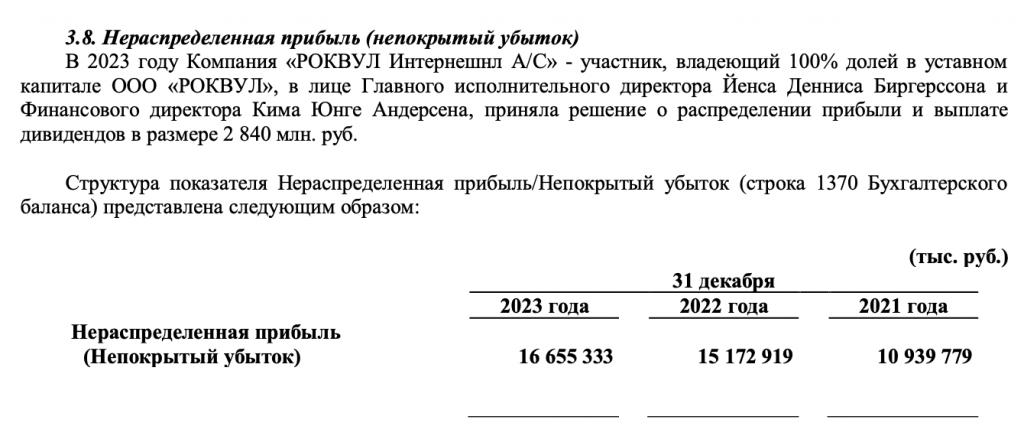
According to the financial statements of the Moscow-based company Rockwool, in 2023, the executive director of Rockwool International, which is the founder of the Russian part of the Rockwool group, Jens Dennis Birgersson, and CFO Kim Junge Andersen decided to distribute the Russian legal entity’s profits and pay dividends in the amount of 2.84 billion rubles (28.6 million euros). In 2024, a decision was made to pay dividends in the amount of 90 million rubles (0.9 million euros).
The statement that Rockwool’s Russian business «did not receive support from the Danish headquarters or any other companies in the Group in the form of expertise, equipment, spare parts, investments, raw materials or anything else» is not confirmed by the public reports of Russian legal entities. According to the reports of all Rockwool subsidiaries operating in Russia, bilateral transactions continued not only in 2022, but also later, up to 2024. There are no reports available for 2025 yet.
Bilateral transactions between all four Russian companies were mainly linked to the main founder, the Danish Rockwool International (Danish registry number 54879415), but there were also transactions with other companies in the group from the European Union and the United Kingdom. The transactions mainly consisted of mutual consulting services, which are reflected in the financial statements of Russian companies, as well as the supply of goods to and from Russian companies.
Commodity relations between Rockwool and other foreign companies in the group with Russian legal entities effectively ended in 2022. That year, the Russian companies Rockwool, Rockwool-Sever, and Rockwool-Volga received goods worth 633.6 million rubles (8.4 million euros) from various companies in the Rockwool group. In the opposite direction, i.e. from Russian legal entities to foreign ones, the flow of goods was not much less — 523.9 million rubles (6.9 million euros). In 2023, the trade relationship ended: only the Russian company Rockwool received goods worth 200,000 rubles (2,000 euros) from the British company Rockwool Limited.
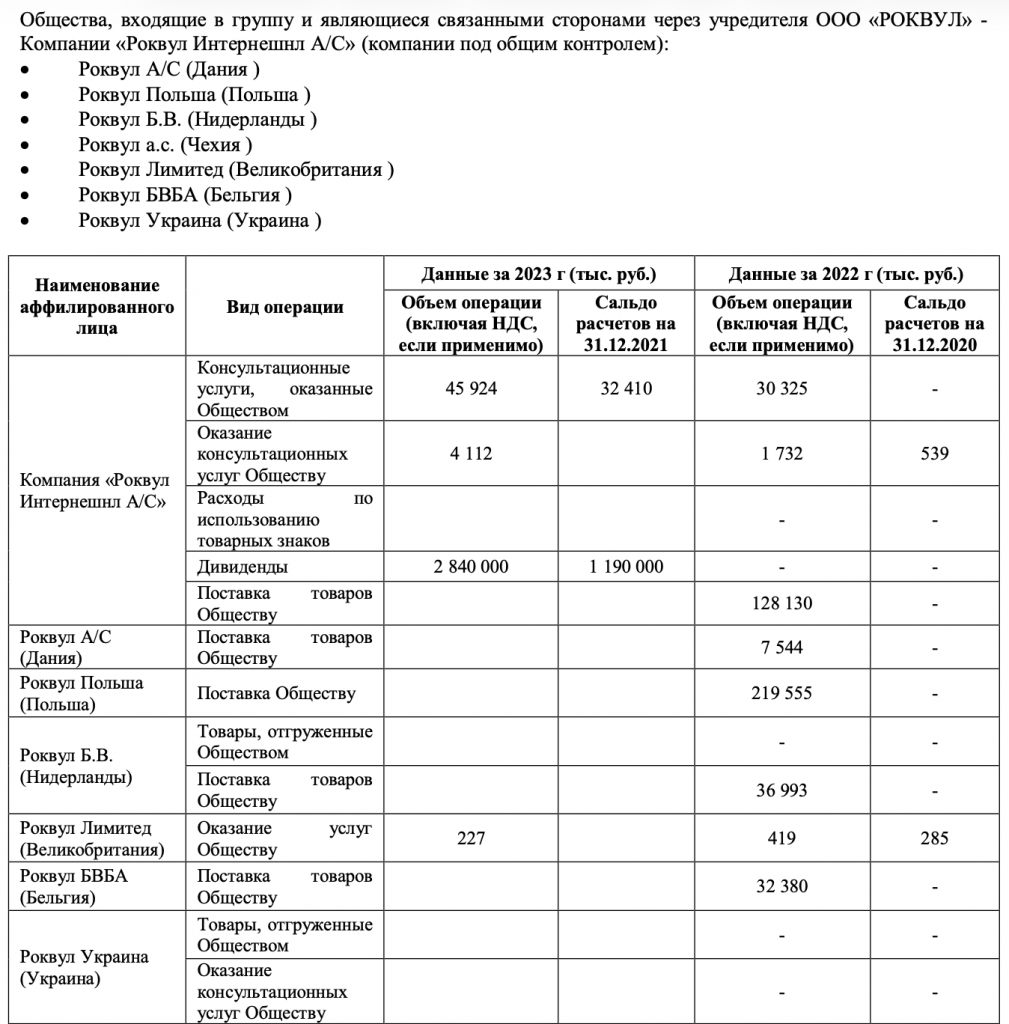
The so-called consulting services continued to be provided not only in the first year of the Russian invasion of Ukraine, but also in subsequent years. Even in 2024, Rockwool International continued to provide certain consulting services to its Russian subsidiaries, with a total value of 700,000 rubles (6,600 euros). At the same time, Russian representative offices provided Rockwool International with consulting services worth 2.4 million rubles (22,000 euros) in 2024.
***
«Isolationist opportunism did not save the company. «Passive ownership» in this story looks like a convenient smokescreen. Rockwool publicly explained why it continues to operate in Russia, and Russian financial reports confirm this: factories were operating, revenue was growing, profits soared, decisions on dividends were made, and intra-group transactions continued.
But in the Russian reality, ownership turned out to be a conditional thing: it is enough to change the «temporary manager» and control over the business disappears. And loud statements about violations of «international rules» sound like an afterthought — when all that can be done with Russian assets is to record losses and damaged reputation.
* Euro exchange rate:
as of December 31, 2021 — 84.07 rubles
as of December 31, 2022 — 75.66 rubles
as of 12/31/2023 — 99.19 rubles
as of December 31, 2024 — 106.10 rubles.
The Chronicles.Media team